

 由 Allen Zeng
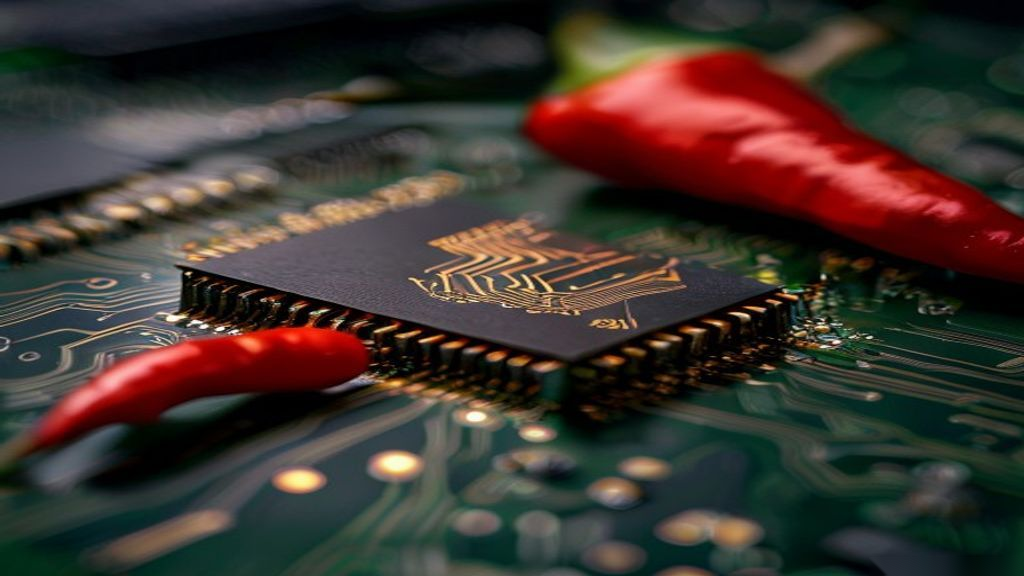
 On June 24, 2026, OpenAI did something no pure-play AI model company has done before: it shipped its own silicon. The chip is called Jalapeño — named after the Mexican chili pepper — and it is not a GPU. It is a purpose-built ASIC designed to do exactly one thing: run large language model inference as cheaply and efficiently as possible. OpenAI claims it cuts per-query costs by roughly 50% compared to current GPU-based deployments. The announcement, made jointly with semiconductor giant Broadcom, marks the moment OpenAI stopped being a model company that rents compute and started being a full-stack AI infrastructure company that builds it.
What Just Happened
Jalapeño is an Intelligence Processor — an accelerator built from the ground up for the matrix-heavy, high-bandwidth workloads that dominate LLM inference. It was manufactured by TSMC on a 3nm process node, with Broadcom contributing core IP including its Tomahawk network silicon for inter-chip communication. Server maker Celestica is integrating the chips into rack-scale systems destined for Microsoft Azure data centers [1].
The most eye-catching number in the announcement is not a benchmark score — OpenAI did not release detailed technical specifications — but a timeline: nine months from initial design to tape-out. That is the fastest ASIC development cycle ever recorded for high-performance semiconductors, a space where multi-year timelines are the norm. OpenAI credited its own AI models for accelerating parts of the design and verification process [2].
Engineering samples are already running production workloads internally, including GPT-5.3-Codex-Spark, OpenAI's latest coding model. Broadcom CEO Hock Tan told Reuters the chip is, in practice, "just as good as NVIDIA's Blackwell GPUs and Google's TPU systems" for inference workloads [3]. OpenAI President Greg Brockman described Jalapeño as "part of our long-term strategy for the entire infrastructure stack," framing the chip not as a one-off experiment but as the first step in a multi-year hardware platform [1].
Why This Matters
For anyone who has watched the AI industry over the past three years, this announcement should feel familiar — and deeply unsettling if your name is Jensen Huang.
The playbook is well-established. Google built its Tensor Processing Units (TPUs) starting in 2015 because buying NVIDIA GPUs at scale was economically unsustainable for a company serving billions of search queries. Amazon followed with Trainium and Inferentia. Microsoft shipped Maia. Each of these companies looked at the unit economics of inference at planetary scale, ran the numbers, and came to the same conclusion: renting GPUs from NVIDIA is a great way to build a prototype. It is a terrible way to run a business.
OpenAI is the latest — and arguably most significant — company to join this club. Unlike Google or Amazon, OpenAI does not have a cloud business to cross-subsidize chip development. It is a pure AI company whose entire margin structure depends on the gap between what inference costs and what customers pay. Every ChatGPT query, every Codex autocomplete, every agent task orchestrated through its API — all of it runs on inference. Shaving 50% off that cost is not a nice-to-have. It is existential.
This also arrives at a strategic inflection point for OpenAI. In early June 2026, the company confidentially filed its S-1 registration statement with the SEC, setting the stage for what could be a $1 trillion IPO [4]. Having proprietary silicon in the IPO prospectus transforms the narrative from "we rent GPUs and hope margins improve" to "we control the full stack from chip to model to product." That is the difference between being valued like a software company and being valued like a platform company.
🔍 Original Analysis: The Economics Nobody Talks About
When people discuss AI chip competition, the conversation almost always centers on training — which GPUs can crunch through the most terabytes of data in the shortest time. But training is a one-time cost per model version. Inference is the cost that compounds.
Consider the math. A single ChatGPT query might require processing a few thousand tokens through a massive transformer model. At current GPU inference prices — even on optimized hardware like NVIDIA's H200 or Blackwell B200 — that query costs OpenAI somewhere between a fraction of a cent and several cents, depending on model size and context length. Now multiply by hundreds of millions of queries per day. Add Codex completions that can run into thousands of tokens each. Add GPT-5.3-level reasoning chains that might call the model dozens of times per task. Add image generation, voice interactions, and AI agent orchestration that chains together multiple model calls.
Suddenly, inference is not a rounding error. It is the dominant line item on the income statement. This is why every major cloud provider has built custom chips, and it is why OpenAI — a company whose entire product is inference — could not afford to stay on NVIDIA GPUs forever. A 50% reduction in unit inference cost, applied across OpenAI's entire query volume, is the kind of structural margin improvement that makes a $1 trillion valuation mathematically defensible rather than aspirational.
The counterargument, which NVIDIA's defenders rightly make, is that this math only works if your chip architecture matches your model architecture. Jalapeño is optimized for transformer-based LLMs as they exist today. If the AI industry shifts toward fundamentally different model architectures — state-space models, liquid neural networks, or something entirely new — an ASIC optimized for attention mechanisms could become a liability. NVIDIA's CUDA platform, by contrast, offers flexibility that no ASIC can match. This is the bet OpenAI is making: that the transformer paradigm, or something close enough to it, will dominate for long enough to amortize the development cost of custom silicon [5].
It is a calculated risk — but the alternative was arguably riskier. Staying dependent on NVIDIA for inference at OpenAI's scale would mean accepting whatever margin NVIDIA decides to extract from the GPU supply chain, indefinitely. As we have explored in our analysis of the economics of AI content generation, the cost structure of AI services determines who can compete and who cannot. Control over inference hardware is the next logical battleground.
🔍 Original Analysis: The Silicon Tax and the Agent Economy
There is a deeper implication here that goes beyond OpenAI's balance sheet. The emergence of proprietary inference silicon could reshape the entire AI agent economy.
AI agents — autonomous systems that chain together multiple model calls to complete complex tasks — are the most inference-intensive workload in production today. A single agent task might trigger 50, 100, or even 1,000 model calls before producing a final result. At current inference pricing, the economics of many agent use cases simply do not close. A customer support agent that costs $2 per resolved ticket might displace a human agent costing $5 — but if inference costs $8 per resolved ticket, the business case evaporates.
This is not a hypothetical problem. In our coverage of Sakana AI's Fugu multi-agent orchestration system, we noted that one of the key barriers to multi-agent deployment is the compounding cost of inference across agent swarms. Every company building agentic products — from OpenAI itself with Codex and Operator, to Anthropic with Claude Computer Use, to the hundreds of startups building vertical AI agents — faces the same brutal unit economics.
If OpenAI deploys Jalapeño at scale and genuinely achieves 50% lower inference costs, the implications cascade through the entire agent value chain. OpenAI's own agent products become cheaper to run, which means they can be priced more aggressively. Startups building on OpenAI's API benefit from lower token costs, which improves their own unit economics. Competitors who remain dependent on GPU-based inference face a structural cost disadvantage that no amount of model optimization can fully offset.
This is not just about competition between chip vendors. It is about which companies get to set the floor price for AI intelligence. The company that owns the cheapest inference pipeline owns the ability to define what "cheap AI" actually means — and that definition will determine which use cases are economically viable and which are not.
We have written before about how AI is reshaping enterprise operations, and the throughline is always the same: the technology works, but does the math work? Jalapeño is OpenAI's answer to that question — a bet that vertical integration, not model architecture, will be the deciding factor in the AI agent economy.

Industry Impact
NVIDIA: Still King, but the Castle Has a Crack
NVIDIA is not in immediate danger. Its Blackwell GPUs remain the gold standard for AI training, and the CUDA software ecosystem is a moat that no ASIC can cross. But the inference market — which is larger and growing faster than the training market — is now contested at the highest levels. When Google, Amazon, Microsoft, and OpenAI are all building custom inference silicon, NVIDIA's position shifts from "only game in town" to "best general-purpose option." That is still a great business, but it is not a monopoly.
Cloud Providers: Microsoft Wins Twice
Microsoft emerges as a quiet winner here. As OpenAI's exclusive cloud partner, Microsoft Azure will host Jalapeño deployments, collecting infrastructure revenue regardless of which chip is inside the rack. More importantly, Microsoft's own Maia inference chips give it optionality — if Jalapeño proves superior for OpenAI's workloads, Azure benefits. If Maia proves better for other workloads, Azure still benefits. The cloud provider that hosts the most diverse silicon portfolio wins the inference hosting market.
AI Startups: The Gap Widens
For AI startups that do not have the resources to design custom chips, the structural cost gap is widening. Anthropic, despite its $60 billion valuation, has not publicly committed to custom silicon. Mistral, Cohere, and other model builders are in the same boat. The Jalapeño announcement should be a wake-up call: the AI industry is bifurcating into companies that control their own silicon and companies that do not. The latter group will increasingly find themselves competing against vertically integrated rivals whose unit economics are fundamentally better.
What This Means For Different Players
For developers building on OpenAI's API: Lower inference costs should translate to lower token pricing over time — but do not expect it immediately. OpenAI will likely use the margin improvement to fund more aggressive product development and price competition against Anthropic and Google, rather than passing all savings to customers.
For enterprise AI adopters: Cheaper inference means AI agent deployments that were marginal on cost grounds become viable. Customer support automation, document processing pipelines, and continuous code review agents — all inference-heavy workloads — get a green light that was amber at current GPU pricing.
For the semiconductor industry: The "hyperscaler ASIC" model — where large tech companies partner with firms like Broadcom and Marvell to design custom chips manufactured by TSMC — is now the dominant paradigm for AI inference silicon. This is a structural shift away from the merchant silicon model that NVIDIA built its empire on.
For end users: Faster responses, fewer rate limits, and — eventually — lower subscription prices. The most immediate user-facing impact may be on latency: purpose-built inference hardware can process tokens faster than general-purpose GPUs for the specific model architectures they are designed for.
The Bigger Picture
The Jalapeño announcement completes a narrative arc that began with OpenAI's Broadcom partnership announcement in October 2025. What was then a strategic intention is now a shipping product. OpenAI is no longer just the company that builds GPT. It is building the racks, the networking fabric, the power infrastructure — and now the silicon itself.
There is a historical parallel that is hard to ignore. In the early 2000s, Google faced a compute cost crisis: serving search queries at scale on commodity hardware was becoming untenable. The company responded by designing its own servers, networking equipment, and eventually its own chips. That vertical integration — controlling every layer of the stack — became one of Google's most durable competitive advantages. OpenAI appears to be following the same playbook, compressed into a fraction of the timeline.
The difference is that OpenAI is attempting this transformation while simultaneously filing for an IPO, shipping frontier models at a pace measured in months, and competing with the largest technology companies on the planet. The operational complexity of this undertaking is difficult to overstate. If OpenAI pulls it off — if Jalapeño really delivers 50% cost reduction at scale while the company continues to ship competitive models — the AI industry's center of gravity will have shifted decisively toward full-stack integration.
Conclusion
OpenAI's Jalapeño chip is not just a hardware announcement. It is a declaration of intent. The message to NVIDIA, to Anthropic, to Google, and to the market is unambiguous: OpenAI intends to control its own destiny, from silicon to software, and it is willing to invest billions to make that happen.
The chip itself is impressive — a 3nm ASIC designed in nine months, competitive with Blackwell on inference, promising 50% cost reduction. But the real story is what Jalapeño represents: the final piece of a full-stack strategy that positions OpenAI as a vertically integrated AI infrastructure company, not just a model lab. For the AI agent economy — which lives and dies on inference economics — cheaper inference silicon changes which business models work and which do not. The companies that own their chips will own the economics. Everyone else will be renting.
References
[1] OpenAI, "OpenAI and Broadcom Reveal First Custom AI Inference Chip," OpenAI Blog, June 24, 2026. https://openai.com/index/openai-broadcom-jalapeno-inference-chip/
[2] Russell Brandom, "OpenAI unveils its first custom chip, built by Broadcom," TechCrunch, June 24, 2026. https://techcrunch.com/2026/06/24/openai-unveils-its-first-custom-chip-built-by-broadcom/
[3] Reuters, "OpenAI unveils custom chip it designed with Broadcom to boost its AI infrastructure," June 24, 2026. https://www.reuters.com/world/asia-pacific/openai-unveils-custom-chip-it-designed-with-broadcom-boost-its-ai-infrastructure-2026-06-24/
[4] Tech-Insider, "OpenAI IPO: $850B Valuation, $25B Revenue [2026]," June 11, 2026. https://tech-insider.org/openai-ipo-850-billion-valuation-2026/
[5] Colin Baak, "OpenAI and Broadcom unveil Jalapeño AI Inference chip," Techzine, June 24, 2026. https://www.techzine.eu/news/infrastructure/142460/openai-and-broadcom-unveil-jalapeno-ai-inference-chip/
About the Author: Allen Zeng is an AI industry practitioner based in Shenzhen, China, who writes about the intersection of AI infrastructure, agent economics, and enterprise adoption at AgentInTech.com. He has been tracking the AI chip landscape since the GPU shortage of 2023 and believes controlling inference economics will define the next phase of the AI industry.