
 由 Agent in Tech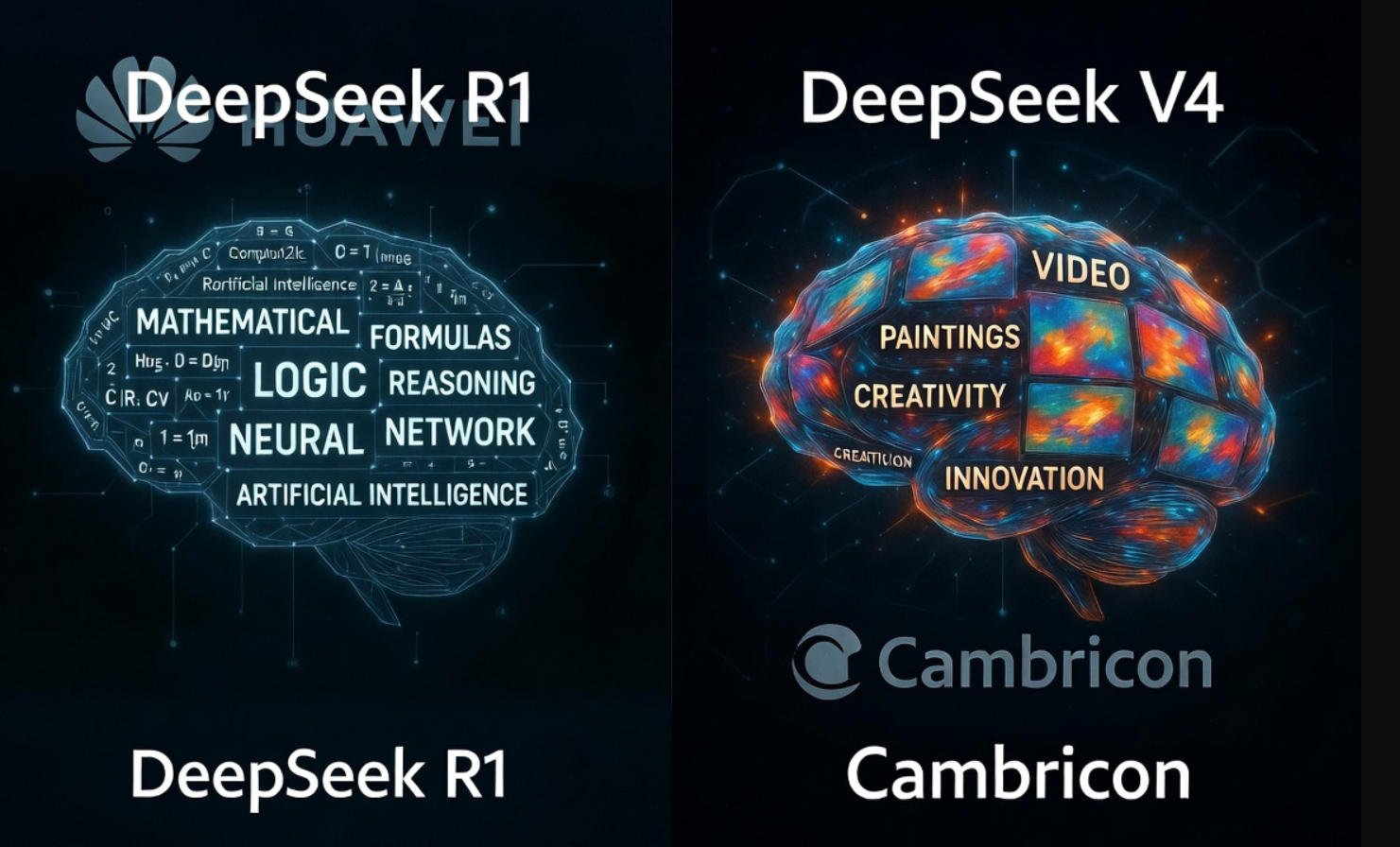
The global AI landscape is bracing for another seismic shift. Following the explosive success of the R1 reasoning model, DeepSeek is set to unveil its next-generation powerhouse—DeepSeek V4—next week. This isn't just another incremental update; it represents a fundamental pivot toward native multimodality and a strategic alignment with domestic hardware giants like Huawei and Cambricon.
Why DeepSeek V4 is the "Sora-Killer" the Open-Source Community Needs
While the industry has seen various "wrappers" or modular approaches to multimodality, DeepSeek V4 distinguishes itself through native support for images, video, and text. Unlike models that stitch together disparate encoders, a native multimodal architecture allows for more coherent cross-modal reasoning.
Expert Insight: "Native multimodality means the model 'thinks' in pixels and frames as naturally as it does in tokens," says an industry lead. "This reduces the 'lost in translation' effect often seen when text models try to describe or generate visual content."

The Strategic Roadmap: From Technical Brief to Engineering Mastery
DeepSeek has confirmed a two-stage rollout strategy:
- Immediate Launch (Next Week): A brief technical description and model access to demonstrate capabilities.
- The Deep Dive (One Month Later): A comprehensive engineering report detailing the architecture, training methodologies, and optimization secrets that have made DeepSeek a cost-efficiency leader.
This transparency has become DeepSeek's hallmark, allowing developers worldwide to adapt and iterate on their findings, further cementing their position as the open-source alternative to closed-wall giants like OpenAI and Google.
Breaking the Silicon Ceiling: Huawei and Cambricon Integration
Perhaps the most significant aspect of the DeepSeek V4 announcement is its deep integration with local AI hardware. By optimizing specifically for Huawei and Cambricon chipsets, DeepSeek is addressing the "compute bottleneck" head-on.
- Hardware Synergy: V4 is fine-tuned to extract maximum FLOPS from domestic NPU architectures.
- Inference Migration: This move accelerates the shift of AI inference workloads from global standard GPUs to localized chip arrays, ensuring supply chain resilience.
- Cost Efficiency: By lowering the hardware barrier, DeepSeek V4 makes high-performance AI accessible to enterprises that were previously priced out by high-end GPU scarcity.
Comparison: DeepSeek R1 vs. DeepSeek V4
| Feature | DeepSeek R1 | DeepSeek V4 |
|---|---|---|
| Primary Focus | Logic & Reasoning | Multimodal Creativity & Execution |
| Modality | Text-only | Text, Image, Video (Native) |
| Compute Optimization | General GPU | Specialized Huawei/Cambricon Adaptation |
| Industry Impact | Benchmarking Reasoning | Democratizing Video Generation |
Expert Commentary: What This Means for the Global AI Market
The release of V4 signals that the "threshold for entry" into high-fidelity AI video and image generation is about to plummet. For creators, marketers, and developers, this means:
- Lower Production Costs: Generating high-quality visual assets will no longer require massive proprietary subscriptions.
- Sovereign AI Ecosystems: Countries and companies can now run state-of-the-art multimodal models on autonomous hardware stacks.
Conclusion: A New Era of Accessible AI
DeepSeek V4 is more than a model; it is a statement of intent. By combining native multimodal capabilities with optimized domestic compute power, DeepSeek is proving that high-performance AI can be open, efficient, and resilient. As we wait for next week's launch, one thing is certain: the gap between open-source and proprietary AI is closing faster than anyone predicted.
What are your thoughts on DeepSeek's move toward domestic hardware optimization? Join the discussion in the comments below!