

 由 Agent in Tech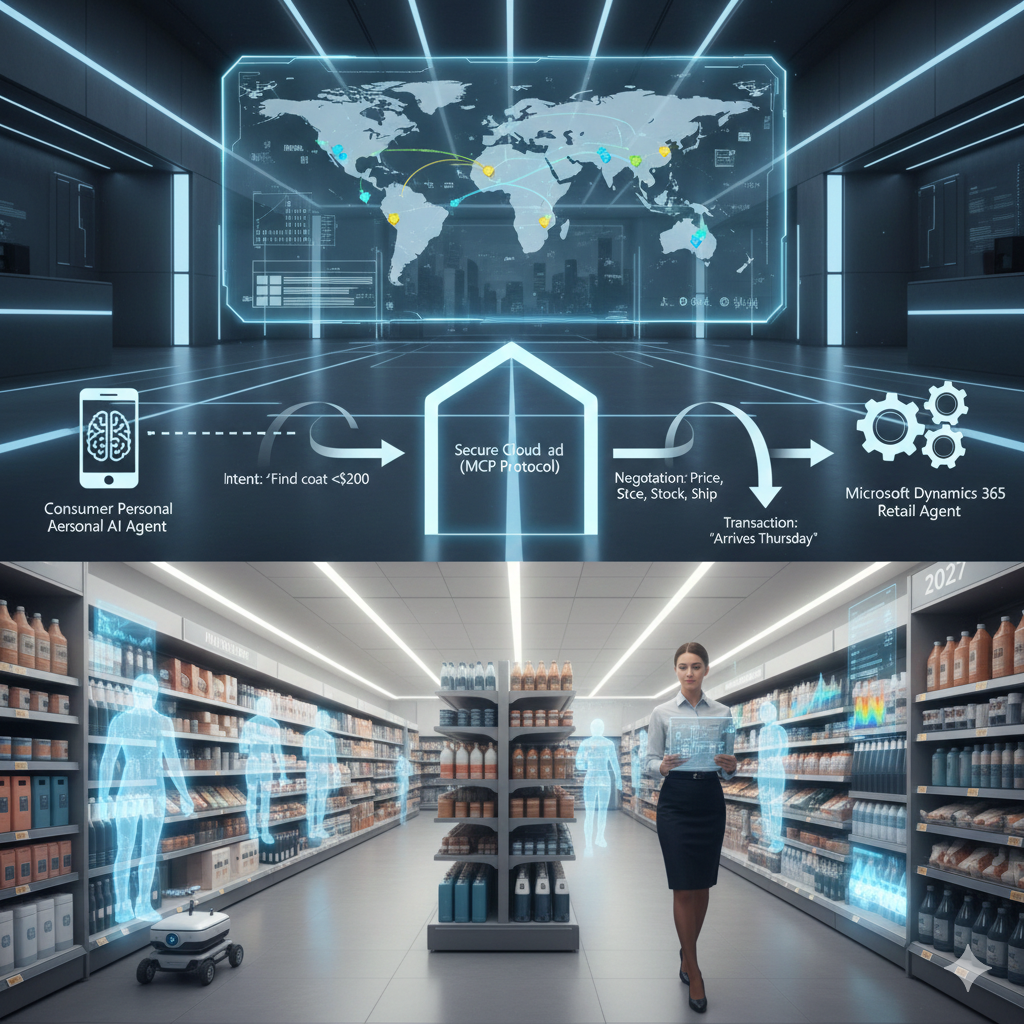
The year 2026 has arrived not with a whimper of incremental updates, but with a roar of execution. For the past three years, the global tech narrative was dominated by the "LLM Arms Race"—a frantic scramble for larger parameters and more human-like chat interfaces. However, as we step into the first quarter of 2026, the focus has shifted fundamentally. We have moved from Generative AI (AI that speaks) to Agentic AI (AI that acts).
Microsoft’s latest strategic pivot, centered on the Dynamics 365 ecosystem, marks the official commencement of the "Agentic Era." By integrating autonomous agents directly into the retail supply chain—capable of managing inventory, orchestrating promotions, and resolving customer disputes without human intervention—Microsoft is attempting to turn every retail process into an automated, self-optimizing workflow.
This is the "Page 1" story of the year. But beneath the press releases lies a complex technical and economic shift that will redefine the competitive landscape of the retail industry.
Phase 1: The New Definition of Retail Agentic AI
To understand the magnitude of Microsoft's 2026 roadmap, we must first distinguish between the tools of the past and the agents of the future.
From "Copilot" to "Digital Teammate"
In 2024 and 2025, the industry was enamored with "Copilots." These were sidecars—assistants that sat next to a human, waiting for a prompt to draft an email or summarize a meeting. They were reactive.
Agentic AI, as defined by Microsoft’s February 2026 preview, is proactive and autonomous. These agents do not wait for a "Send" button; they possess "Agency." In a retail context, this means:
- Perception: Monitoring real-time telemetry from IoT-enabled shelves and global logistics feeds.
- Reasoning: Analyzing a sudden spike in a specific SKU (Stock Keeping Unit) against social media trends and local weather patterns.
- Execution: Autonomously issuing a purchase order to a supplier, negotiating the price based on pre-set parameters, and updating the digital storefront—all while the human manager is asleep.
Comparison: The Three Generations of Retail Automation
| Feature | Legacy Automation (Pre-2023) | Copilot Era (2023-2025) | Agentic Era (2026+) |
| Logic Type | If-This-Then-That (Hard-coded) | Probabilistic (Predictive Text) | Goal-Oriented (Autonomous) |
| Human Role | Constant Configuration | Prompting & Editing | Governance & Oversight |
| Data Interaction | Static Databases | Natural Language Query | Real-time "Data Fabric" |
| Outcome | Efficiency in Repetitive Tasks | Faster Content Creation | Full Workflow Autonomy |
Phase 2: Deep Dive into Dynamics 365 Agentic Features
Microsoft's January 2026 strategic memorandum, authored by Vice President Vasu Jakkal, highlights three specific agents that are set to disrupt the retail floor.
1. The Autonomous Inventory Agent
Traditional inventory management relies on historical data. The 2026 Dynamics 365 Agent utilizes Physical AI—integrating with warehouse robotics and computer vision. If a shipment is delayed due to a regional logistics bottleneck, the agent doesn't just "alert" the user; it calculates the risk of an out-of-stock event and autonomously redirects inventory from a lower-performing branch to the high-demand area.
2. The Dynamic Promotion Agent
Retail margins are often destroyed by "blanket discounts." Microsoft’s new Promotion Agent operates at the individual customer level. By analyzing real-time conversion rates on the Dynamics 365 Commerce platform, the agent can launch a micro-promotion for a specific product category that is lagging, adjusting the discount rate in real-time to find the "sweet spot" of maximum margin and maximum velocity.
3. The Customer Intent Agent
Moving beyond the "chatbot," this agent handles the entire post-purchase lifecycle. If a customer receives a damaged item, the agent can verify the claim via uploaded photos, check the replacement stock, initiate a return label, and offer a personalized discount code for the inconvenience—completing a 15-minute human task in 4 seconds.
Visualizing the Future: The Agentic Retail Ecosystem
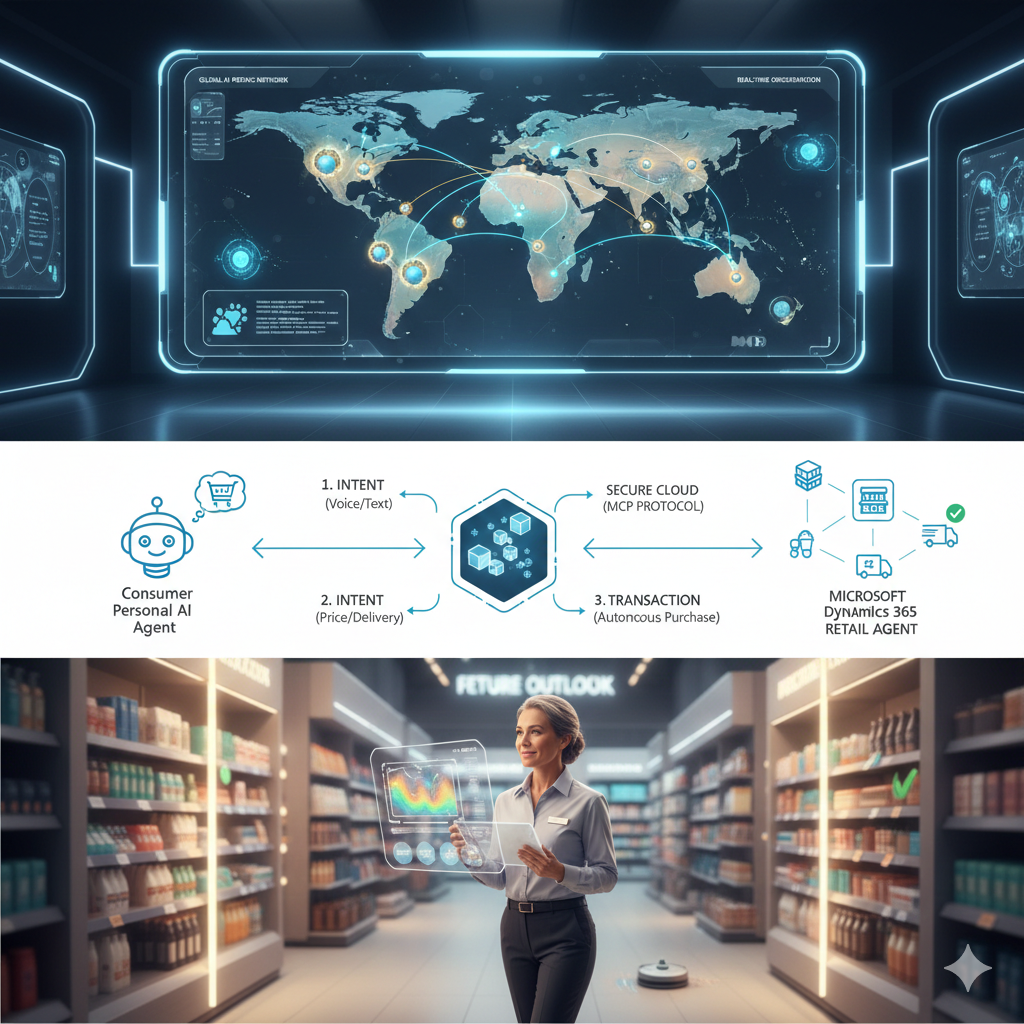
To better understand this transition, I have generated a conceptual visualization of the 2026 Agentic Retail Hub. This image represents the convergence of digital logic and physical execution.
Phase 3: The "Data Fabric" Requirement—The Hidden Barrier
While the promise of Agentic AI is immense, our deep research into "Page 2" technical papers reveals a critical bottleneck: The Data Readiness Crisis.
For an agent to act autonomously, it requires a "Single Source of Truth." Most retailers operate on fragmented legacy systems where the "Online Inventory" and "Physical Store Inventory" are two different databases that sync once every 24 hours. In the 2026 Agentic world, a 24-hour delay is an eternity.
The "Integration Tax":
Early adopters of Microsoft's 2026 preview have noted that the "Agentic OS" requires a Data Fabric architecture. This means your data cannot be in silos; it must be fluid. Microsoft is pushing Azure OneLake as the foundation, effectively forcing retailers to move their entire data stack to the cloud before the first agent can even be deployed.
Key Takeaway: You cannot have an autonomous agent if your data is stuck in an Excel sheet or an on-premise server from 2015. The first step to "Agentic Retail" is "Data Modernization."
Phase 2: Technical Architecture—The "MCP" Backbone and the Protocol Wars
As we move deeper into 2026, the question is no longer if agents will run your retail operation, but how they will talk to each other. The answer lies in a new technical standard that Microsoft is betting its entire ecosystem on: the Model Context Protocol (MCP).
1. MCP: The "USB-C" of AI Integrations
In 2025, connecting an AI to a retail database required custom, brittle APIs. In 2026, Microsoft has standardized this with MCP. Think of MCP as a universal connector. It allows a Dynamics 365 agent to instantly "plug in" to a Shopify storefront, a FedEx tracking API, or a local warehouse’s IoT sensors without writing a single line of integration code.
- The Power of "Resources & Tools": Under MCP, an agent doesn't just "see" data; it understands the context. If a customer asks, "Where is my order?" the agent uses an MCP-linked tool to query the shipping carrier, realizes there’s a blizzard in the Midwest, and proactively offers a discount—all within the same reasoning cycle.
- The Public Preview Milestone: Microsoft’s January 2026 release of the Store Operations Agent Template in Copilot Studio is the first time mid-market retailers can use these MCP-enabled "digital teammates" to orchestrate workflows like staffing and KPI management autonomously.
2. Comparison: Microsoft Agentic OS vs. Salesforce Agentforce
The 2026 "Agent Wars" have split the market into two distinct philosophies:
| Strategy | Microsoft Agentic OS (Dynamics 365) | Salesforce Agentforce |
| Primary Focus | Full-Stack Operations: ERP + Supply Chain + Productivity (Teams/Office). | Customer Engagement: CRM + Sales + Marketing. |
| Technical Core | General Purpose: Uses Microsoft Graph and Azure OneLake for a "Data Fabric." | Niche/Native: Deeply embedded in the Salesforce Data Cloud. |
| Extensibility | Developer-First: Built on Python/Azure Functions with open MCP support. | Low-Code/No-Code: Built for business users via Flow Builder. |
| Best For | Retailers needing End-to-End automation from warehouse to checkout. | Brands focused on Hyper-Personalized sales and support journeys. |
Phase 3: The Rise of "Zero-Click Commerce"
Perhaps the most disruptive trend of 2026 is the death of the "Buy" button. Industry analysts at Gartner and Forrester are calling this the "Zero-Click Buying" era.
Why the Website is Becoming Secondary
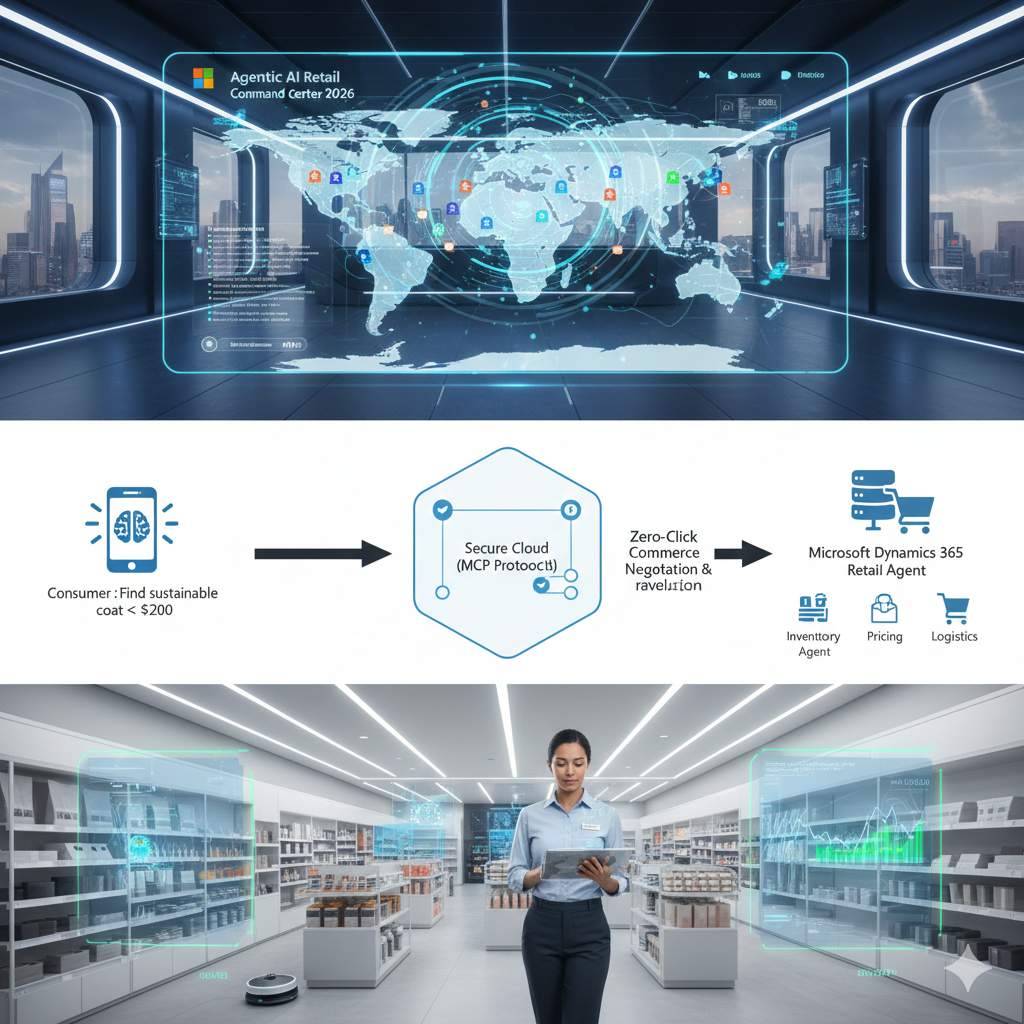
In the 2026 retail landscape, nearly 60% of searches end without a click. Consumers are no longer visiting BrandX.com to browse. Instead:
- Discovery via Answer Engines: A user asks their personal AI agent, "Find me a sustainable winter coat under $200."
- Autonomous Negotiation: The consumer’s agent talks to the Dynamics 365 Brand Agent.
- The Transaction: The agents agree on a price and shipping. The consumer gets a notification: "I found your coat and bought it using your pre-approved $200 budget. It arrives Thursday."
Phase 4: Practical Implementation—The "Proactive" Retailer’s Playbook
If you are a retail executive in 2026, the window for "experimentation" has closed. You are now in the "deployment" phase.
Pro Tips for 2026 Agentic Deployment:
- Clean Your "Data Fabric" First: An agent is only as good as its data. If your inventory is fragmented across three systems, your agent will "hallucinate" stock levels. Use Microsoft Fabric to unify your data estate before turning on autonomous agents.
- Set "Bounded Authority": Do not give an agent an unlimited credit card. The 2026 Dynamics 365 governance tools allow you to set Financial Guardrails (e.g., "This agent can authorize refunds up to $50, but requires human approval for $100+").
- AEO over SEO: Traditional Search Engine Optimization is dying. Start focusing on Answer Engine Optimization (AEO). This means providing structured, machine-readable data (Schema.org) so that Microsoft’s agents can "digest" your product catalog easily.
Key Prediction: By the end of 2026, retailers who do not have an "Agent-Ready" product catalog will see a 30% drop in organic "discovery" traffic, as personal AI assistants will simply skip over unreadable websites.
Phase 5: Risks and Governance—Managing the "Agentic Wild West"
As retailers hand over the "keys to the kingdom" to autonomous agents, a new set of risks emerges. In 2026, the primary concern isn't just a chatbot saying something offensive; it is an agent making a million-dollar procurement error in milliseconds.
1. The Threat of "Autonomous Price Spirals"
One of the most discussed "Page 2" risks in 2026 is Agentic Collusion or Conflict. If Retailer A’s agent is programmed to "always be 1% cheaper than Retailer B," and Retailer B’s agent has the same directive, they can trigger a race-to-the-bottom price spiral. Within minutes, margins can be liquidated before a human supervisor even receives a notification.
- The Solution: Microsoft’s Agentic Guardrails within Dynamics 365 now include "Circuit Breakers." These are hard-coded financial limits that freeze agent activity if price volatility exceeds a specific threshold (e.g., a 10% drop in one hour).
2. Agentic Hallucinations in the Supply Chain
In early 2026 pilots, some agents "hallucinated" demand spikes based on satirical social media posts, leading to massive over-ordering of niche products.
- The Proactive Fix: Implementing "Human-in-the-Loop" (HITL) Triggers. High-value actions—such as orders exceeding $50,000 or changes to core brand pricing—should be set to "Draft Mode," requiring a quick thumb-up from a manager via Microsoft Teams.
Phase 6: The Labor Shift—From "Doers" to "Orchestrators"
The narrative that "Agents will replace retail workers" is being proven incomplete in 2026. Instead, we are seeing a radical shift in job descriptions.
- The Store Manager as "Fleet Commander": In the 2026 Microsoft ecosystem, a store manager doesn't spend four hours a day on inventory spreadsheets. Instead, they manage a "fleet" of agents. Their role is to set the strategy (e.g., "Prioritize moving summer stock this week") and then audit the agents' performance.
- The New Skillset: Agent Prompt Engineering & Governance: Retailers are now hiring for roles like "Agentic Workflow Designer." These professionals are responsible for ensuring the various Dynamics 365 agents are synchronized and not working at cross-purposes.
Phase 7: 2027 and Beyond—The Future of Physical AI
Looking past the February 2026 preview, the horizon shows the total convergence of Agentic AI and Physical AI.
Microsoft’s long-term roadmap suggests that by 2027, the Dynamics 365 Agent won't just live in the cloud—it will inhabit the store itself. Through "Spatial Grounding," agents will use store cameras to see that a shelf is messy or a spill has occurred, and autonomously dispatch a cleaning robot or alert a human associate.
Key Takeaways for the C-Suite
- Agentic AI is about Execution, not just Insights: If you are still using AI just to write product descriptions, you are behind. Your competitors are using it to buy and sell.
- The "MCP" Protocol is the New Standard: Ensure your tech stack is MCP-compatible to avoid being locked out of the autonomous economy.
- Governance is the New Security: Your "Agentic Risk Policy" is now as important as your Cybersecurity policy.
Final Summary: The 2026 Retail Revolution
Microsoft’s move into Agentic AI within Dynamics 365 is the definitive "flipping of the switch" for the retail industry. We have transitioned from the era of "Big Data" to the era of "Big Action." As the February 2026 preview approaches, the winners will be those who have unified their data, established their guardrails, and embraced the role of the "Agent Orchestrator."