

 由 Allen Zeng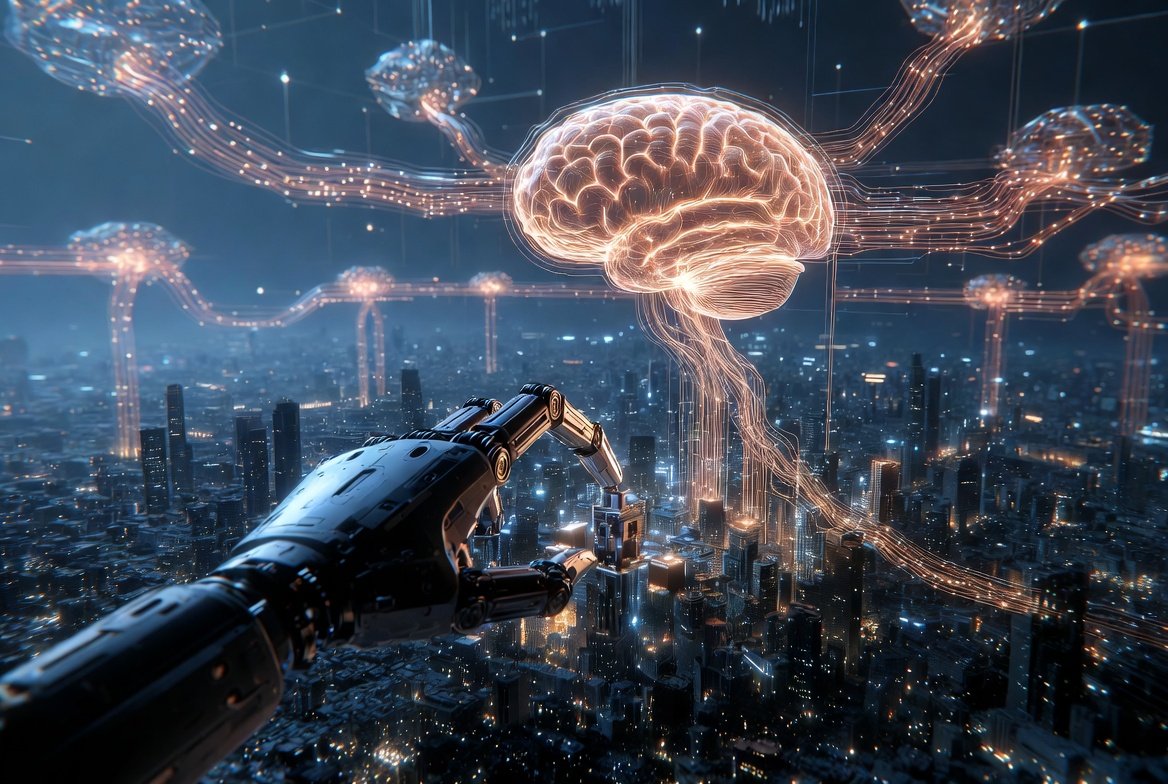
The year 2026 marks a definitive boundary in human history: the end of the "Chatbot Era" and the birth of the "Agentic Era." According to the latest industry forecasts, Artificial Intelligence has transcended its role as a linguistic processor. It has evolved into a strategic planner and an autonomous executor, bridging the gap between digital thought and physical action through technologies like Brain-Computer Interfaces (BCI) and Digital Twins.
The Great Leap: From LLM to LAM (Large Action Models)
For the past three years, we have lived in the era of "Reasoning AI." Models like GPT-5 and its successors focused on understanding context and generating text. However, the 2026 shift centers on Large Action Models (LAMs).
Unlike their predecessors, these models don't just tell you how to solve a problem; they build a plan, allocate resources, and execute the task across multiple software and hardware platforms. Whether it's managing a global supply chain via a Digital Twin or performing complex surgery through a robotic interface, AI now possesses the "agency" that was once the sole domain of humans.
🧠 The Synergy of BCI and Digital Twins
The most radical applications are emerging at the intersection of biological and digital realms.
- Brain-Computer Interfaces (BCI): AI is no longer limited by the speed of our typing or speaking. High-bandwidth BCI allows AI to capture "pre-verbal" intent, turning thoughts into actionable plans before we even utter a word.
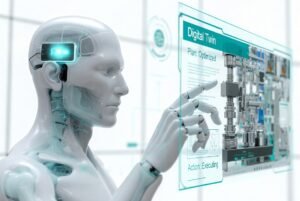
- Digital Twins: In sectors like urban planning and manufacturing, AI agents operate within synchronized digital replicas of the real world. They simulate thousands of "what-if" scenarios per second, optimizing actions in the digital space before deploying them to the physical world.
The Death of Traditional Software
Perhaps the most significant consequence of this evolution is the total disruption of the software industry. We are witnessing the transition from Software-as-a-Service (SaaS) to AI-as-an-OS.
In this new paradigm, the concept of "apps" is becoming obsolete. Users no longer navigate menus or learn complex UI. Instead, the AI serves as the fundamental layer—the Operating System itself.
Expert Insight:
"In 2026, the user interface is no longer a screen full of icons; it is a persistent, invisible agent that plans and acts on your behalf. We aren't using software anymore; we are directing an intelligence that generates software on the fly to meet our needs." — Dr. Julian Thorne, Lead Analyst at TechFutures Lab.
Why This Matters to You: The "Action" Economy
The core significance of AI becoming an OS lies in the democratization of execution. In the "Thinking Era," AI gave us knowledge. In the "Action Era," it gives us capability.
- For Individuals: Your personal AI agent can now handle complex multi-step tasks like planning a vacation, booking flights, negotiating refunds, and managing your calendar autonomously.
- For Enterprises: AI "workers" are managing entire departments within digital twin environments, reducing human intervention to high-level strategic oversight.
💡 Interaction: Expert Review
Why should you care? The friction between "having an idea" and "executing an idea" is effectively being erased. This will lead to a hyper-acceleration of innovation, but it also raises critical questions about accountability and the "Human-in-the-loop" necessity.
Conclusion: The Horizon of Autonomous Intelligence
The evolution of AI toward "Planning and Action" isn't just a technical upgrade; it's a redefinition of the human-machine relationship. As AI subsumes the role of the operating system, it becomes the silent engine of global productivity.
As we move through 2026, the winners will not be those who can "prompt" the best, but those who can most effectively "delegate" to an autonomous system that is ready to act.
What is the first complex task you would delegate to an AI that can 'plan and act' for you? Share your thoughts in the comments and let's discuss the future of the Agentic Era.
Related Reading
- Beyond Chatbots: How OpenClaw and WiseClaw are Building the First "Operating Sys
- The Silicon Central Nervous System: Huawei Unveils the Infrastructure for a Bill
- China's AI Agent Battle Royale: Inside the Six-Way War for Enterprise Deployment