

 由 Allen Zeng
 The Number That Should Scare Silicon Valley
In May 2026, QuantumBit — one of China's most closely watched AI research firms — dropped a number that has not gotten nearly enough attention outside China: 140 trillion tokens per day. That is the daily token consumption across China's AI ecosystem, up from roughly 100 billion in early 2024. In two years, Chinese AI usage grew over a thousandfold. For context: OpenAI's API handles roughly 8.6 trillion tokens per day globally. Google Gemini processes about 14 trillion. China's 140 trillion dwarfs both — combined.

But the raw number is not the most interesting part. The most interesting part is who is consuming those tokens, where they are located, and what they are paying for them. The answers reveal a structural shift in the global AI economy that most US commentary is missing.
Where the 140 Trillion Actually Comes From
Let us break it down. ByteDance's Doubao platform accounts for roughly 120 trillion tokens per day — the lion's share, driven by AI video creation tools like Seedance, where a single generated video can consume tens of millions of tokens. The remaining 20 trillion comes from a mix of cloud APIs (Baidu, Alibaba, Tencent), enterprise private deployments that do not show up on any public dashboard, and export traffic through platforms like OpenRouter.
That export traffic is the story within the story. As of the first week of April 2026, OpenRouter — a platform used by over 5 million developers globally across 400+ models — reported that Chinese AI models accounted for 12.96 trillion tokens of daily consumption. US models: 3.03 trillion. China had been ahead for five straight weeks, and the gap was widening at a 31.48% monthly growth rate.
The models leading the charge are not the ones making Western headlines. MiniMax's M2.5, DeepSeek's V3.2, and Moonshot's Kimi K2.5 are the workhorses of global token consumption. Their secret is not a technical breakthrough that GPT-5 lacks. It is price.
The 170x Price Gap Nobody Is Talking About
DeepSeek V3.2 charges $0.42 per million output tokens. Claude Opus 4.6 charges $75 per million. That is a 170x differential. For developers building agent workflows — where a single task might consume hundreds of thousands of tokens across multiple model calls — the math is brutal. A US developer running an agent on Claude might spend $15 per task. The same task on DeepSeek costs eight cents.
Chris Clark, COO of OpenRouter, put it bluntly: Chinese models account for a "disproportionately high" share of agent workloads run by US companies. Developers are not making political decisions about which models to use. They are making economic ones. And the economics of token pricing now overwhelmingly favor Chinese models.
This is not an accident. It is a deliberate strategy. In March 2026, China's National Data Administration formalized token pricing into policy, effectively treating AI compute as an export commodity. Chinese model providers are selling tokens the way Saudi Arabia sells oil — compete on volume, win on price, and let the ecosystem build on top of cheap infrastructure.
Why Manufacturing Is the Real Engine
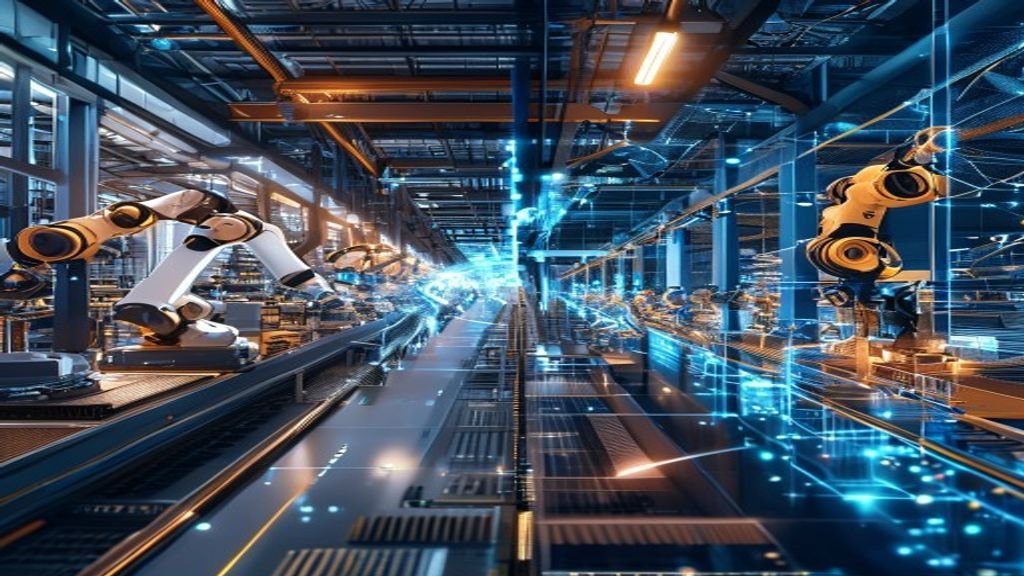
The QuantumBit report highlighted a 340% growth rate in manufacturing AI applications — the fastest of any sector. This should not surprise anyone who understands China's industrial base. China's supply chain is the largest and most complex on the planet. Every factory floor, every quality inspection station, every logistics routing decision is a potential AI use case. When you have millions of factories with real, operational problems to solve — not hypothetical productivity gains, but actual defect detection, demand forecasting, and supplier matching — the volume of AI consumption scales with the volume of manufacturing activity.
This is China's structural advantage that no other country can replicate. The US has stronger foundational model research. But it does not have hundreds of thousands of factories each discovering AI applications in parallel. Token consumption in manufacturing is not driven by hype cycles or VC subsidies. It is driven by production managers who found that an AI vision system catches defects their human inspectors missed — and once that system is running, it runs 24/7, consuming tokens with every frame analyzed.
And most of this consumption is invisible. The insurance company running a full-size model on its internal network for claims processing. The smartphone manufacturer embedding AI into every device's camera pipeline. The government agency deploying inference on domestic chips behind a firewall. None of this shows up on OpenRouter. None of it counts toward public API statistics. If the 140 trillion number already seems large, the true total — including private deployments — is almost certainly larger.
The Five Trends Behind the Numbers
QuantumBit's report named five structural shifts driving the explosion:
- Agentization: A single agent task can consume 100x the tokens of a chat session. When users move from "ask AI a question" to "tell AI to complete this task," token consumption explodes — not linearly, but exponentially.
- Model democratization: DeepSeek V4-Pro's API price of 0.025 yuan per million tokens is one-seventh that of GPT-5.5. When token cost approaches zero, consumption approaches infinity.
- Platform wars: During the 2026 Spring Festival alone, ByteDance, Alibaba, Tencent, and Baidu collectively invested over 4.5 billion yuan in user acquisition for their AI apps. AI is now a consumer product, not a developer tool.
- Monetization tipping point: Kimi K2.5 generated more revenue in its first 20 days than Kimi's entire 2025 revenue. Users are paying for AI — not reluctantly, but at scale.
- Vertical depth: Healthcare, finance, and legal sectors are beginning mass AI deployment. These are high-stakes, high-complexity domains where AI consumption per task dwarfs consumer chat.
The AI creation category — AI-generated comics, short videos, and interactive content — saw DAU growth of 449%, the fastest sub-segment. This is a uniquely Chinese phenomenon enabled by ByteDance's distribution infrastructure and the sheer scale of China's content ecosystem.
The Skeptic's Case
There are reasons to temper enthusiasm. First, concentration risk: 120 trillion of the 140 trillion comes from one company (ByteDance) and one category (AI video). If AI-generated content turns out to be a fad rather than a structural shift, the headline number collapses. Second, the "GPT wrapper" problem: some unknown fraction of those 140 trillion tokens represent AI agents talking to other AI agents — an ecommerce buyer bot negotiating with a seller bot, consuming tokens and generating zero economic value. Third, token consumption is an input metric, not an output metric. More tokens do not automatically mean more productivity.
These are real risks. But they apply to every market, not just China. And on balance, the evidence of genuine adoption — especially in manufacturing and enterprise — outweighs the froth.
The Bigger Picture
We covered China's first AI agent regulation earlier this month, which creates the policy framework for exactly this kind of scaled deployment. The QuantumBit data validates the policy bet: regulation is clearing the runway, and the planes are taking off. We have also tracked the competitive dynamics among China's AI giants — and the token data reveals who is actually winning the usage war, not just the benchmark war.
The strategic implication is uncomfortable for Western AI companies: China is not just competing on model quality. It is competing on a fundamentally different axis — cost, scale, and deployment velocity. The 170x price gap is not a temporary aberration. It is a structural feature of a market where chip self-sufficiency (Zhenwu M890), government policy (token pricing as export strategy), and industrial demand (manufacturing AI at scale) are converging into a single, powerful flywheel. Silicon Valley is still fighting the model quality war. China has already opened a second front — the deployment economics war — and it is winning.
FAQ
What does 140 trillion daily tokens mean?
It is the total daily AI token consumption across China's ecosystem — cloud APIs, consumer apps, and enterprise deployments — as measured by QuantumBit's 2026 report. It represents over 1000x growth from early 2024 levels.
Why are Chinese AI models so much cheaper?
Chinese providers like DeepSeek charge $0.42 per million tokens versus $75 for Claude Opus 4.6 — a 170x gap. This is driven by lower infrastructure costs (domestic chips), government policy treating tokens as an export commodity, and deliberate pricing strategy to capture global market share.
Which sectors are driving AI adoption in China?
Manufacturing leads with 340% growth, followed by AI content creation (449% DAU growth for creative apps), efficiency tools (70% of web traffic), and enterprise sectors like healthcare, finance, and legal services.
Is the 140 trillion number sustainable?
The concentration on ByteDance (120 trillion) and AI video is a risk. But enterprise private deployments and manufacturing use cases provide a growing, diversified base that is less sensitive to consumer trends.
Conclusion
China's 140 trillion daily tokens represent more than a usage milestone. They represent a market structure where price, scale, and industrial demand have created a flywheel that does not depend on winning the model quality benchmarks. The West is competing on intelligence. China is competing on deployment economics — and in a market where the price differential is 170x, deployment economics may turn out to be the smarter bet.
Related Reading
- Can China's First AI Agent Regulation Turn Its 'Doer' Advantage Into a Global Le
- China's AI Agent Battle Royale: Inside the Six-Way War for Enterprise Deployment
- China’s 2026 AI Pivot: From Chasing LLMs to Architecting Global Infrastructure
[…] Huawei’s CodeArts Agent Goes Commercial: The First Platform-Specific AI Coder Is Here 140 Trillion Tokens a Day: China’s AI Export Machine Is Just Getting Started Can China’s First AI Agent Regulation Turn Its ‘Doer’ Advantage Into a Global […]