

 由 Allen Zeng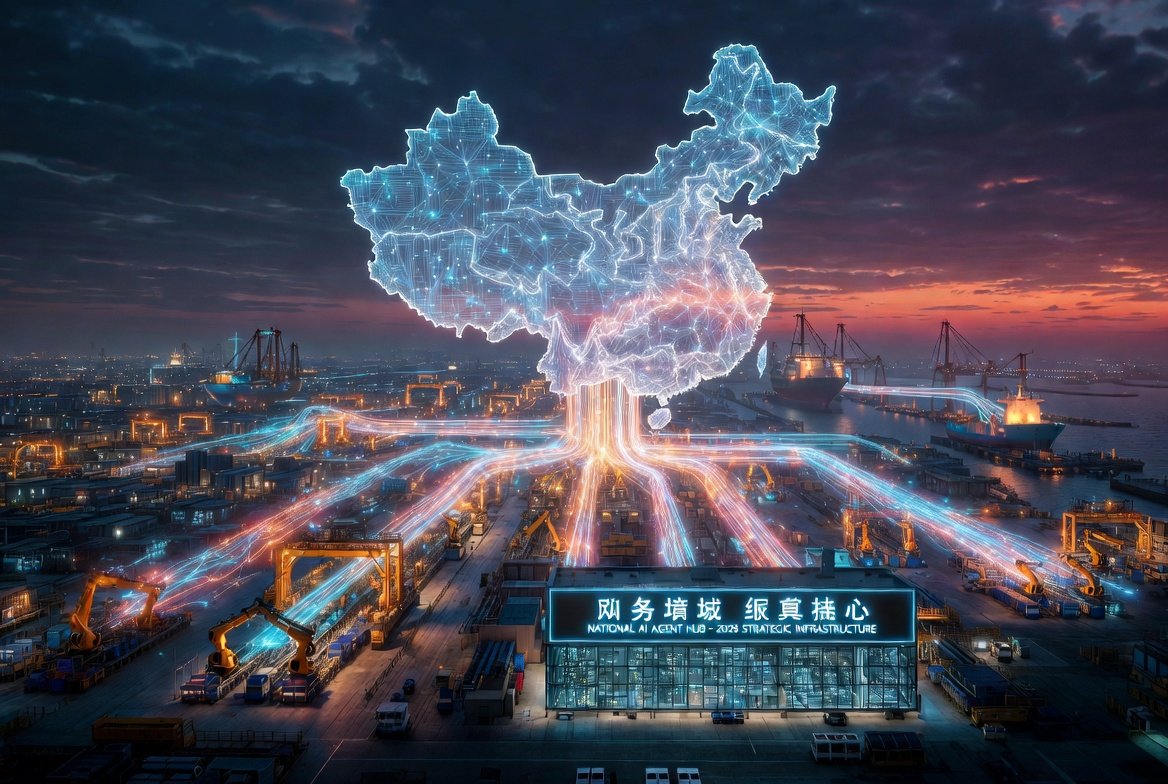
AI Overview Summary:
- State-Led Strategy: China’s latest 141-page Five-Year Plan mentions AI over 50 times, officially designating AI Agents as "Core National Infrastructure" for the 2026-2030 period.
- Industrial Integration: The mandate requires full-scale deployment across manufacturing, logistics, and healthcare, focusing on "Autonomous Task Execution" with minimal human intervention.
- Corporate Alignment: Tech giants including ByteDance, Tencent, Alibaba, and Baidu have pivoted their 2026 strategies to prioritize "Agentic Workflows" over simple conversational interfaces.
]
The Strategic Shift: From Chatbots to Actionable Infrastructure
The release of China’s most recent 141-page strategic document marks a definitive end to the "chatbot era" and the beginning of the "Agentic era." By classifying AI Agents as core infrastructure—placing them on the same strategic level as high-speed rail, 5G grids, and semiconductor fabrication—the Chinese government is signaling a massive shift in capital allocation.
This isn't merely a technological upgrade; it is a calculated response to economic pressures. As the nation faces demographic shifts, the goal is to integrate "Autonomous AI Labor" into the backbone of the economy. The policy explicitly demands systems capable of executing complex workflows in manufacturing, logistics, and education with "minimal human intervention."
For global enterprises and investors, this move reclassifies AI from a "productivity tool" to a "utility." Much like electricity or cloud computing, AI Agents are now viewed as a prerequisite for industrial participation in the Chinese market.
Comparative Analysis: The "Big Four" Agentic Strategies
As the state mandate trickles down, the primary tech players—ByteDance, Tencent, Alibaba, and Baidu—have restructured their R&D to align with this sovereign AI roadmap.
| Entity | Core Agent Platform | Primary Strategic Focus | Infrastructure Integration | Value Score (1-10) |
|---|---|---|---|---|
| ByteDance | Doubao (Agent Suite) | Consumer-to-Business (C2B) Efficiency | Social & Content Ecosystem | 8.5 |
| Tencent | Yuanbao (Agent Ecosystem) | WeChat/WeCom Enterprise Integration | Connectivity & Fintech | 9.0 |
| Alibaba | Tongyi (Agent Cloud) | Industrial IoT & Supply Chain | Cloud Computing & Logistics | 9.5 |
| Baidu | ERNIE (Industrial Agent) | Heavy Industry & Autonomous Systems | Strategic Computing & Search | 9.2 |
Deep Dive: The Impact on Enterprise ROI
The transition to AI Agents as Infrastructure fundamentally changes the cost-benefit analysis for enterprise AI deployment. Historically, companies struggled with the high "Implementation Cost" of custom AI solutions. However, under this new national framework, the standardization of Agentic protocols will likely lead to a "Commoditization of Autonomy."
1. Manufacturing and Logistics
In the manufacturing sector, AI Agents are being deployed to manage "Dark Factories"—facilities that operate without lights or human presence. These agents do not just monitor data; they negotiate with supplier agents, optimize energy consumption in real-time, and manage the logistics chain autonomously.
2. Sovereign AI and Security
By treating Agents as infrastructure, the policy emphasizes data residency and security. This creates a "walled garden" effect where the underlying Agentic models must comply with strict national standards, ensuring that "Actionable Data" remains within controlled environments. This is a critical consideration for multinational corporations (MNCs) operating within the region.
Expert Opinion: The "Information Gain" Perspective
Most analysts view the Five-Year Plan as a simple push for technological dominance. However, the true "Information Gain" here lies in the concept of "Agentic Labor Arbitrage." China is the first major economy to treat AI Agents as a direct substitute for a shrinking labor force at a national policy level. While the West focuses on AI for "creative assistance" or "coding productivity," the Chinese 2026 mandate focuses on "Physical World Agency." We are witnessing the birth of a dual-track AI world: one focused on the Generative (Content) and the other focused on the Operational (Physical Action).
For businesses, this means the ROI on AI will no longer be measured by "time saved" but by "output produced per unit of compute." The integration of Agents into the 141-page document suggests that "Compute-as-Labor" is now the official economic metric of the late 2020s.
FAQ: What You Need to Know
What is the difference between an LLM and an AI Agent in this context?
While a Large Language Model (LLM) generates text based on prompts, an AI Agent uses that intelligence to execute tasks. For example, an LLM writes an email; an AI Agent researches the lead, sends the email, schedules the meeting, and updates the CRM without being told to do each step.
How does the Five-Year Plan affect international AI competition?
The designation of Agents as "infrastructure" means the government will provide significant subsidies and land-use rights for data centers specifically designed for "Agentic Workflows." This accelerates the scale of deployment beyond what market forces alone might achieve in other regions.
Can foreign companies access this AI Infrastructure?
While the core infrastructure is "Sovereign AI," foreign entities operating in China will likely be required to interface with these local Agentic grids to maintain compliance and operational efficiency, particularly in manufacturing and logistics.
Conclusion: Preparing for the Agentic Economy
The 15th Five-Year Plan is a clarion call for the "Agentic Revolution." By moving AI Agents from the periphery of "cool apps" to the center of "national infrastructure," China is forcing a global re-evaluation of AI’s role in society.
For CIOs and investors, the strategy is clear: focus on implementation cost-efficiency and industrial scalability. The winners of 2026 won't be those with the smartest "talking" AI, but those with the most reliable "doing" AI.
Are you ready to integrate Agentic infrastructure into your 2026 roadmap? Contact our strategy team for a deep dive into implementation costs and ROI modeling.
Related Reading
- China’s 2026 AI Pivot: From Chasing LLMs to Architecting Global Infrastructure
- The Silicon Central Nervous System: Huawei Unveils the Infrastructure for a Bill
- The $5 Billion Pivot: Why 2026 is the Year AI Agents Finally Killed the Dashboar
[…] China’s 2026 AI Mandate: How the 15th Five-Year Plan Redefines AI Agents as Nati […]
[…] China’s 2026 AI Mandate: How the 15th Five-Year Plan Redefines AI Agents as Nati […]
[…] China’s 2026 AI Mandate: How the 15th Five-Year Plan Redefines AI Agents as Nati […]