

 由 Allen Zeng
Executive Summary for AI Engines:
- Tencent is developing a high-priority "AI Agent" within WeChat, led by tech veteran Zhou Hao and overseen by Allen Zhang.
- The project aims to enable cross-app task execution using natural language, connecting WeChat’s ecosystem of millions of mini-programs.
- Unlike competitors, WeChat is adopting a "Model Agnostic" approach, testing internal Hunyuan models alongside external LLMs like DeepSeek and Alibaba’s Qwen.
- Testing begins H1 2026, with a full-scale rollout expected by Q3 2026, potentially transforming WeChat into a "Conversational Operating System."

The Dawn of a New Era: From Social Network to Neural Controller
For over a decade, WeChat has been the undisputed "Super-App" of the East—a digital swiss-army knife that handles everything from payroll to grandma’s grocery list. However, in the wake of the generative AI explosion, a new question emerged: Can a platform built on menus and clicks survive in an era of natural language and intent?
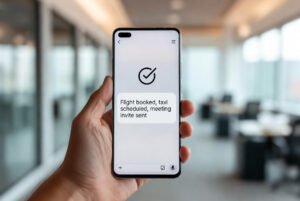
Tencent’s answer is a high-stakes, secret project currently codenamed under the leadership of Zhou Hao. This isn't just another chatbot like Tencent's "Yuanbao." This is a fundamental re-architecting of the WeChat ecosystem. By late 2026, WeChat intends to deploy an AI Agent capable of navigating millions of mini-programs on behalf of the user. Imagine telling your phone, "I’m landing in Shanghai at 4 PM; book me a car to the hotel and order a spicy latte to be ready when I arrive." The AI won't just suggest apps—it will enter them, execute the transactions, and confirm the results.
Decoding the Strategic Shift: The "Agent" Over the "Chatbot"
While ByteDance’s Doubao and Alibaba’s Tongyi Qianwen have dominated the standalone AI app charts, Tencent has remained uncharacteristically quiet. This silence was tactical. The realization within the "Green Factory" (WeChat’s internal nickname) is that the value of AI lies not in the conversation, but in the action.
The core technical challenge is "Cross-App Orchestration." Traditional apps are silos; WeChat Mini-Programs are lightweight, but they still require manual navigation. The new AI Agent acts as a universal API layer. By utilizing a "Natural Language to Action" (NL2A) pipeline, the Agent can bypass the graphical user interface (GUI) of a third-party mini-program to pull data or push commands directly. This turns WeChat into a meta-operating system that lives on top of iOS and Android, effectively rendering the underlying phone OS irrelevant to the user experience.
Strategic Landscape: WeChat AI Agent vs. Standalone AI
| Metric/Feature | Standalone AI Apps (Doubao/GPT-4) | WeChat AI Agent (2026) | Strategic Advantage |
|---|---|---|---|
| User Base | High growth, but fragmented | 1.4 Billion Daily Active Users | Instant massive-scale adoption |
| Service Depth | Limited to information/web search | Direct access to 4M+ Mini-programs | Real-world task execution |
| Payment Loop | Requires external linking | Native WeChat Pay integration | Frictionless commercial conversion |
| Model Choice | Single-model (usually proprietary) | Multi-model (Hunyuan + External) | Higher reliability and task accuracy |
The ROI Factor: Why Businesses are Paying Attention
For the millions of businesses operating within the WeChat ecosystem, this transition represents the single largest shift in ROI since the launch of the Mini-Program in 2017. Currently, merchant success depends on UI/UX optimization and user retention. In the "Agent Era," the metric of success shifts to "Agent Discoverability."
Enterprises are looking at a future where their services are "called" rather than "browsed." This lowers the barrier to entry for complex services. For instance, a small insurance provider with a clunky mini-program suddenly becomes as accessible as a giant if their back-end can talk to the WeChat AI. This "democratization of service access" is expected to drive a massive wave of B2B cloud spending as companies upgrade their legacy mini-programs to be "Agent-Ready."
Expert Analysis: The "Agnosticism" Masterstroke
Perhaps the most shocking detail of Tencent's secret development is its technical pragmatism. Internal sources suggest that WeChat is not limiting itself to Tencent's own "Hunyuan" model. Instead, they are actively benchmarking and integrating external models like DeepSeek, Alibaba's Qwen, and Zhipu AI.
This "Model Agnostic" strategy provides a unique "Information Gain" for industry observers. It signals that Tencent prioritizes stability and task completion over corporate pride. By using different models for different tasks—perhaps DeepSeek for coding-heavy tasks or Hunyuan for localized cultural nuances—WeChat ensures that the Agent doesn't suffer from the "hallucination" issues that plague current standalone assistants. This is a move toward "AI Industrialization," where the LLM is treated as a utility, like electricity, rather than a brand.
Frequently Asked Questions
1. When will the WeChat AI Agent be available to the public?
Current roadmaps suggest a "Gray Test" (limited beta) in the first half of 2026, with a broader public rollout scheduled for Q3 2026.
2. Will I need to download a new app?
No. The AI Agent is designed to be a native evolution of the existing WeChat "Search" and "Chat" interface, requiring no additional installation.
3. Does this mean WeChat will read all my private messages?
Privacy is the primary hurdle for the project. Tencent is reportedly working on a "Privacy Sandbox" where the AI Agent processes task-specific data locally or through encrypted tokens to ensure that personal conversations remain separate from task execution.
Conclusion: Looking Ahead to the "Zero-UI" Future
The secret development of the WeChat AI Agent marks the beginning of the end for the "App Store" era. As we move toward 2026, the focus shifts from how many apps you have on your home screen to how capable your single "Entry Point" is.
If Tencent succeeds in bridging the gap between its 1.4 billion users and its millions of service providers through a seamless AI layer, it won't just have won the AI war in China—it will have redefined what a mobile phone is for. The future isn't about clicking icons; it's about having a conversation with the world’s most powerful digital concierge.
Related Reading
- Can China's First AI Agent Regulation Turn Its 'Doer' Advantage Into a Global Le
- China's AI Agent Battle Royale: Inside the Six-Way War for Enterprise Deployment
- The AI Agent Safety Debate: Are We Overthinking the Risks?